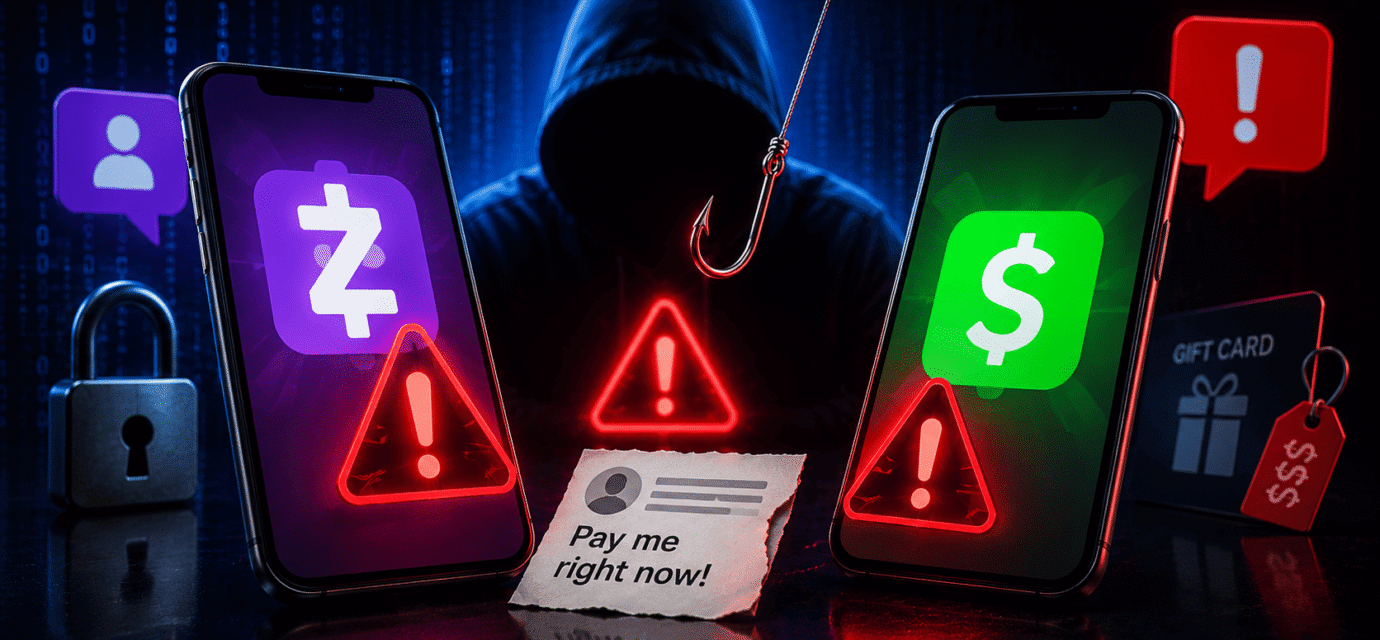
Common Zelle and Cash App Scam Warning Signs
Digital payment apps such as Zelle and Cash App have made sending money faster and more convenient than ever. Millions of people use these services daily to pay friends, family members, landlords, and small businesses. While these platforms are generally safe when used correctly, they have also become popular targets for scammers looking to steal money from unsuspecting users.
Unlike credit card transactions, many digital payment transfers are instant and difficult to reverse. Once money is sent to a scammer, recovering it can be extremely challenging. This is why recognizing scam warning signs before sending money is so important.
Understanding how scammers operate can help protect your finances and prevent costly mistakes.
Why Scammers Target Zelle and Cash App Users
Scammers prefer payment apps because transactions happen quickly.
These platforms offer:
- Instant transfers
- Easy account creation
- Simple payment processes
- Wide user adoption
Once funds are transferred, the money may disappear before victims realize they have been scammed.
Criminals often create fake stories, fake businesses, and fake emergencies to convince people to send money voluntarily.
Warning Sign #1: Requests for Immediate Payment
One of the most common scam tactics involves creating urgency.
Scammers may claim:
- An account will be suspended
- A bill must be paid immediately
- A family member is in trouble
- A package is being held
- A limited-time offer is expiring
Their goal is to pressure victims into acting quickly without verifying the situation.
Whenever someone insists you must send money immediately, slow down and investigate before making a payment.
Warning Sign #2: Unexpected Messages From Strangers
Be cautious when receiving payment requests or messages from people you do not know.
Scammers frequently contact victims through:
- Text messages
- Social media
- Dating apps
- Online marketplaces
They often pretend to be:
- Buyers
- Sellers
- Customer service representatives
- Government agencies
- Family members
Never assume a message is legitimate simply because it appears professional.
Warning Sign #3: Overpayment Scams
Overpayment scams are particularly common on online marketplaces.
A scammer agrees to purchase an item you’re selling and sends more money than requested.
They then claim the extra amount was a mistake and ask you to refund the difference.
Later, the original payment turns out to be fraudulent, leaving you responsible for the refunded amount.
Legitimate buyers rarely overpay intentionally.
If someone sends more money than agreed, proceed with caution.
Warning Sign #4: Fake Customer Support Representatives
Scammers frequently impersonate customer support teams.
You may receive messages claiming to be from:
- Zelle Support
- Cash App Support
- Fraud Department
- Account Verification Team
These fake representatives often ask for:
- Login credentials
- Verification codes
- PIN numbers
- Security information
Legitimate support teams generally do not request sensitive login information through messages.
Always contact support through official channels listed on the app or company website.
Warning Sign #5: Requests to Upgrade to a Business Account
This scam has become increasingly common on Cash App and similar platforms.
A buyer claims they need you to upgrade your account before receiving payment.
They may send fake emails showing:
- Account upgrade fees
- Business account requirements
- Payment release instructions
The scammer then asks you to send money to unlock the payment.
In reality, no payment exists.
Legitimate payment services do not require customers to send money to receive money.
Warning Sign #6: Fake Prize or Giveaway Notifications
Scammers often promise rewards to attract victims.
Messages may claim you’ve won:
- Cash prizes
- Sweepstakes
- Lottery winnings
- Gift cards
- Promotions
Before receiving the reward, victims are told they must pay:
- Processing fees
- Verification fees
- Taxes
- Security deposits
Legitimate prizes do not require winners to send money first.
If someone asks for payment to claim a reward, it is likely a scam.
Warning Sign #7: Requests to Send Money to Receive Money
This is one of the easiest scam indicators to identify.
Scammers may claim:
- They accidentally sent too much money.
- They need verification funds.
- A payment must be unlocked.
- An account must be activated.
In all cases, the victim is instructed to send money first.
Legitimate payments do not require recipients to send funds before receiving money.
If someone asks you to send money to access money, stop immediately.
Warning Sign #8: Fake Rental and Marketplace Listings
Online marketplaces have become a major target for scammers.
Fraudsters often create fake listings for:
- Apartments
- Houses
- Cars
- Electronics
- Concert tickets
Victims are pressured to send deposits through Zelle or Cash App before seeing the item.
After payment is sent, the seller disappears.
Always verify listings in person whenever possible before sending money.
Warning Sign #9: Emotional Manipulation
Scammers frequently use emotions to influence victims.
Common stories include:
- Family emergencies
- Medical crises
- Military deployment
- Travel problems
- Romantic relationships
Their goal is to create sympathy and urgency.
Whenever emotions are heavily involved in a payment request, take extra time to verify the facts.
Warning Sign #10: Requests for Verification Codes
Verification codes are designed to protect your account.
Scammers may ask for:
- Login verification codes
- One-time passwords
- Authentication codes
These codes allow criminals to access accounts.
Never share verification codes with anyone, even if they claim to work for the payment platform.
How to Protect Yourself
Fortunately, several simple habits can reduce your risk significantly.
Only Send Money to People You Know
Use payment apps primarily for trusted friends, family members, and verified businesses.
Double-Check Recipient Information
Verify usernames, phone numbers, and email addresses before sending funds.
Enable Security Features
Use:
- PIN protection
- Biometric authentication
- Two-factor authentication
whenever available.
Avoid Clicking Suspicious Links
Always access payment apps directly instead of through links in messages.
Verify Requests Independently
If someone claims to be a family member, business, or support representative, verify their identity through another communication method.
What to Do If You Are Scammed
If you believe you’ve been targeted:
- Contact the payment platform immediately.
- Report the transaction.
- Change account passwords.
- Enable additional security measures.
- Monitor financial accounts closely.
- Report fraud to local authorities if necessary.
The faster you act, the better your chances of limiting financial damage.
Final Thoughts
Zelle and Cash App provide convenient ways to transfer money, but scammers constantly look for opportunities to exploit users. Most scams share common warning signs, including urgent payment requests, fake customer support messages, emotional manipulation, overpayment schemes, and requests for verification codes.
By staying cautious, verifying payment requests, and understanding how these scams work, you can significantly reduce your risk of losing money and keep your digital payments secure.
Recommended Articles
 How to Protect Your Bank Account From Dark Web Hackers Part : 3
 How to Protect Your Bank Account From Dark Web Hackers Part : 2
 How to Protect Your Bank Account From Dark Web Hackers Part : 1
 How to Spot Fake Security Emails From Banks
 how to protect your bank account from dark web hackers
 How Scammers Use Fake Bank Alerts to Steal Money